








Aboriginal Health and Medical Research Council of NSW 2014
Day 1 Summary
Attendence:
The following information has been collected from the delegates that responded during each Keepad evaluation activity (see Program and Presentations for more information). Of the 70 delegates a vast majority (73%) were from an Aboriginal Community Controlled Health Service (ACCHS) with Tobacco Action Worker/Healthy Lifestyl Worker being the most common job position attending. Having over 50% attendence from the ACCHS sector demonstrates that not only is the A- TRAC Symposium reaching its target audience, but it is supporting a great deal of the Tackling Indigenous Smoking workforce.Keynote Speakers:
Vicki Wade: Cultural Leader, National Heart Foundation Vicki shared her story of growing up as a white-haired Noongar girl in W.A. She described the lack of rights and discrimination her mother and the family suffered and reflected on the experience of discrimination for all Aboriginal Australians describing it as “spears of colonisation driven through the heart of Aboriginal culture”. She also described the maladaptive responses that have resulted from cultural trauma which continues today with 97% of Aboriginal people in Victoria reporting having experienced a racist incident in the past 12 months. “Closing the Gap is becoming another catch cry and cliché” Vicki described the work of the Heart Foundation in combating smoking including school programs, supporting research and influencing policy, and commented on the power of program slogans like “Everyone has a reason to quit”. Vicki finished again on a personal note describing how she is doing this work for her children and her grandchildren - so that they may have healthier lives. David Thomas: Associate Professor, Head of Tobacco Control Research Menzies School of Health Research, Darwin. David acknowledged the Traditional Owners and thanked Dean and the dancers for an inspiring smoking ceremony. David’s presentation focused on a summary of the national, Aboriginal focused Talking about the Smokes Project (TATS), the results of the research, and how those results can be used at both a national level to inform policy, and at local level to inform service delivery by ACCHS who participated. One of the keys to the success of the project was the extent of involvement of Aboriginal people and ACCHS in the process. 35 sites were included across Australia in metropolitan, regional and remote areas, 34 ACCHSs including nine in NSW participated in the project, involving 645 staff and the collection of 2500 stories from community members. David detailed some of the results which have already been fed back to communities and which will be published in a special supplement of the Medical Journal of Australia (MJA) next year (2015). David provided a summary of the keys messages from the research: Many Aboriginal smokers are trying to quit
Social marketing campaigns are useful
Brief Intervention rates are excellent but medicines are under utilised
For research about Aboriginal people to be effective, everyone needs to get involved in the
research process and in particular ACCHSs.
Q & A:
A question was asked about how the TATS research can be applied/used in a local sense and
David explained that results were given back to local sites within three months. Part of this
process involved members of the TATS team discussing the results with ACCHSs staff,
highlighting the data relevant to their community.
A question was asked about what is being done to stop our young people from taking up
smoking. Vicki described education models aimed at families and mums and bubs.
David commented that smoking rates among youth are decreasing and described the benefits
of programs targeting adults having a benefit for children, and of parents expressing to
children that they wish they didn’t smoke and making their homes smoke free. In contrast
there are risks of programs which target smoking amongst youth, some of which in the U.S
have been shown to increase smoking rates.
Many Aboriginal smokers are trying to quit
Social marketing campaigns are useful
Brief Intervention rates are excellent but medicines are under utilised
For research about Aboriginal people to be effective, everyone needs to get involved in the
research process and in particular ACCHSs.
Q & A:
A question was asked about how the TATS research can be applied/used in a local sense and
David explained that results were given back to local sites within three months. Part of this
process involved members of the TATS team discussing the results with ACCHSs staff,
highlighting the data relevant to their community.
A question was asked about what is being done to stop our young people from taking up
smoking. Vicki described education models aimed at families and mums and bubs.
David commented that smoking rates among youth are decreasing and described the benefits
of programs targeting adults having a benefit for children, and of parents expressing to
children that they wish they didn’t smoke and making their homes smoke free. In contrast
there are risks of programs which target smoking amongst youth, some of which in the U.S
have been shown to increase smoking rates.
Session One: Social Media and Health Promotion
It was clearly demonstrated that social media is an economical and effective way for services to reach their communities as part of health promotion programs and campaigns when tailored programs for communities are designed appropriately for and with the audience such as using local role models to help inspire others. “Social Media Savvy 101”: Brett de Hoedt, Hootville Communications This was a lively, fast-paced session with lots of laughing and interaction with the audience. It was designed to inform delegates of how they can use social media more effectively in their health promotion programs and campaigns. Brett, who likes working with non government organisations (NGOs) because he likes their work, describes himself as “not a social media fundamentalist” because he believes in other tools such as other media, merchandising and email. “Email is the workhorse of the Western World” Throughout his presentation Brett compared different forms of media and their use in marketing campaigns, including TV advertising, and digital media. He used examples from anti-smoking campaigns from the US and Australia and highlighted the benefits and limitations of the chosen media. “There is great video potential in tobacco control- video, video, video” In particular Brett compared the pros and cons of Facebook and Twitter which he explained to those who were not familiar with it. He was full of advice on how to get the most out of social media both receiving and broadcasting including creating a personality, and making your posts timely, of strong opinion with links to more sites and a hash tag to track them. Evidence shows that “Video beats text every time” and that adopting an “ask and don’t tell approach” gets more engagement. He also stressed the importance of ‘good news’ messages in social media campaigns and pointed out that spending a lot of money on advertising does not necessarily mean it will be effective. Social media is an important option no matter what your budget. “I learned how to tweet and how to use social media in health promotion” Ready Mob: “Smoking is a tragic love story”: Aaron Ralph and Tyson Morris, Galambila AMS Big T and Little A gave an overview of the Ready Mob program and the events and activities they hold within communities to promote healthy lifestyles. Their program is based on feedback they get from the community about what they want and community engagement is a key feature of everything they do including community events like the ‘Elders Olympics’, the ‘Smoke Free Community Roadshow’ and ‘Children of the Ocean’ and regular activities like ‘Shape Shifters’ – a fitness program. “Our communities don’t want to be talked at anymore” Big T (Tyson Morris) and Little A (Aaron Ralph) showed a fantastic video showcasing their program and staff and talked about the importance of promoting success stories through school programs, social media and how community role models have inspired others.Session Two: Concurrent Sessions
It became evident within workshops that the tailored information and training about NRT as well as more holistic needs of a person helped to better equip workers to support clients quit attempts and well being. It was also identified that all service providers (including hospitals and ACCHSs) need to work better together to support communities to reduce smoking rates. “Brilliant-very informative” (Diabetes Workshop) “Learned more about asthma in that workshop than I have in the last ten years” (Asthma Workshop) “Easy to understand clinical info on providing smoking cessation support to clients” (Tackling Tobacco in the Clinic)Keepad Activity Results
Smoking Cessation Workshop, “It’s good to know when you’re good to go”: Melissa Romeo, Clinical Nurse Consultant. Melissa’s presentation focused on ways of communicating with ACCHS clients to better support them to quit, including providing them with the information even before they are ready. She reinforced the need for workers to build a good rapport with clients, for the conversation to be easy, non judgemental, to share the good news about quitting and for workers to know their tools off by heart so they can focus on engaging with clients. Melissa also looked in detail at the physical and psychological processes of nicotine addiction and the need for clients to expand their red light- ‘I don’t smoke in this situation’, zone. ‘ “Planning to have a plan is not a plan” Melissa also explained clearly the different Nicotine Replacement Therapy (NRT) products and how they should be used. She identified that workers and clients need to have more information about correct use and dosing of NRT and that ACCHS, other primary health care providers and hospitals need to communicate regularly to increase opportunities for, and success of NRT interventions. “Sometimes you win, sometimes you learn!” Q & A:
Questions and comments covered the need for compliance strategies for smoking policies in
ACCHSs to address issues of staff spending too much time on smoking breaks.
On the subject of NRT, an ACCHS worker explained how her team created information flip
charts about each NRT product and gave them to GPs and chemists to help them better
inform clients.
Asthma Workshop: Julie-Ann Garvie, Community Projects and Training Coordinator,
Asthma Foundation NSW
Julie-Ann began the workshop with a personal story about a family member’s smoking habit and the
positive lifestyle changes that resulted from them deciding to give up. She suggested encouraging
clients to prevent their children from being exposed to second hand smoke and reducing their
chance of developing asthma. She noted that there are eight deaths a week from asthma in
Australia. The workshop focused on the need to provide good education to the public about asthma
and how to treat it. 90% of people who suffer from asthma do not use their medication properly. She
explained the symptoms, triggers and medications associated with asthma, the difference between
relievers and preventers and the need for everyone to use spacers, and know asthma first aid.
An important take home message was the importance of health professionals checking correct
patient asthma technique - especially of long-term asthma sufferers as incorrect usage over years
can compound to further incorrect technique, equalling poor asthma medication and outcomes for
the patient.
Diabetes Workshop: Lissa Kirkpatrick, Credentialed Diabetes Educator, Diabetes NSW
Lissa gave an overview of what diabetes is, the different types of diabetes, common acute and
chronic complications, and how to best manage the disease. Lissa described the Feltman Tool
which was developed by the Victorian Aboriginal Community Controlled Health Organisation
(VACCHO) and Diabetes Victoria to facilitate education about diabetes in Aboriginal communities. A
new tool is being developed - the ‘Feltmum’ tool, to help educate pregnant mothers about
gestational diabetes.
Lissa drew particular attention to the changeable risk factors which contribute to developing
diabetes including inactivity, high blood pressure, poor food choices, excess weight, high
cholesterol and smoking. Lissa believes that community education can change attitudes and habits
and help manage and prevent diabetes.
Session Three: Community Engagement
The object of this session was to give a range of examples of how community engagement impacts on the success and outcomes of tobacco programs. Aboriginal Quitline NSW and ACT: David Lester and Lee Bradfield David paid his respects to the traditional owners and gave a brief summary of the collaborative Quitline Enhancement project which held workshops and sought feedback from communities in order to redesign a service which would be more attractive and responsive to Aboriginal people. The result is the Aboriginal Quitline, designed to compliment services in the field and based at St Vincent’s Hospital in Sydney. Lee described how call rates to the Aboriginal Quitline are now 5 times higher than in 2012 and that there is some good news about Aboriginal youth smoking rates which have dropped from 49 to 41%. Evaluation of the program has also shown that direct community engagement results in an increase in calls from those communities. Lee discussed how new smoking laws in 2015 may cause some anxiety in the community and the Aboriginal Quitline is a perfect service to consider a referral to or even to call and have a yarn to one of the Aboriginal or Torres Strait Islander team members at the Aboriginal Quitline on ways to help cutting down to quit smoking. Aboriginal Quitline continues to engage with services on the ground with ongoing visits all around the state. Q & A:
Questions were asked about the cost of calling Quitline from mobiles and Lee explained that
Quitline is happy to call people back and to book in times to call them. Quitline is also on the
list of free calls from prisons.
NSW Ambulance Service: Aboriginal Cardiac Care Program, Dean Pennell
Dean gave an overview of the program which is about raising awareness of the signs and
symptoms of heart attack and encouraging people Aboriginal people to call Triple Zero (000) when
they see signs or experience symptoms of heart attack. This program is the largest in the world in
treating cardiac patients before they get to hospital. Dean played an audio of a Triple Zero (000)
call, showing the series of questions asked and the calm nature of the process- despite the quality
of the NSW service, many people are still reluctant to call and every minute counts.
Dean also talked about the 120 Aboriginal and Torres Strait Islander Paramedics, many of whom
are passionate about working with Aboriginal people. He explained that at the request of
communities, the NSW Ambulance Service can arrange site visits by Aboriginal personnel with the
aim of increasing awareness and engagement. In particular Mark Trebley, an Aboriginal paramedic
has formed strong relationships with communities and helped the Ambulance Service design more
responsive programs for Aboriginal communities.
Q & A:
Comments were made about the cost of the Ambulance Service and how that can be a barrier
to people calling. Many Aboriginal communities have large unpaid bills for Ambulance Services
which was also noted as an unfortunate barrier to calling.
Dean also described programs and culture camps which Mark Trebley runs in schools and
with young people in the Juvenile Justice system.
Dean displayed slides of some amazing artwork created by his Aboriginal colleagues
throughout his presentation.
Riverina Schools Program, “Free, Fresh and Fit”, Sharon Hately and Tracey Collins
Sharon and Tracey began with a video showcasing their school program which builds awareness
around nutrition and smoking. Prevention is their focus and they visit schools around the Riverina
region with an innovative and interactive program which includes putting a fast food burger meal
(including a coke!) in one blender, and berries and milk and yoghurt in another, to allow children to
see, smell and taste (if they dare), what this food is like in their stomachs!
Sharon reckons that running a program with kids lets you know straight away if they’re going to be
engaged and if it’s going to have an impact, and identifies the need to change tactics immediately if
they are not engaged. So far, they’ve been invited back to every school they’ve worked with, to
touch base with the kids and assess any changes in their habits and attitudes.
Q & A:
Sharon and Tracey responded to a question about evaluation of the program and explained
that they send out a five questions on Survey Monkey to teachers and they question kids on
their return visit to see what they’ve retained.
Another question was raised about how they address the question of cost in relation to healthy
options, compared with fast food. Sharon explained that their program is targeted at children
so cost is not the focus-rather they are engaging kids with their senses of smell and taste.
Comments were also made about influencing the menus at school canteens and an
observation that because they are a major source of revenue, there is still a lot of work to be
done to improve the quality of food sold at school canteens.






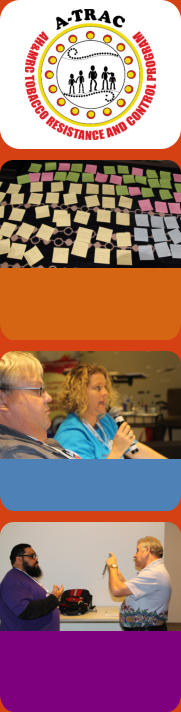
Evaluation doesn’t have to be
long. We had delegates using
post-it notes to let us know what
they liked and didn’t like!
Delegates had the opportunity to
talk about what matters to them
and their communities.
The Advisory Group sought
information by asking delegates
what they thought of the
Symposium using a HD video
camera.
ALL OF THE CHARTS ON THIS PAGE ARE INTERACTIVE!

CLICK ON THE LEGEND KEYS AND CHANGE
WHAT YOU SEE ON THE CHART



