








Aboriginal Health and Medical Research Council of NSW 2014
Yarning Circle Workshop
Session 5: Yarning Circle
The primary objective of the Yarning Circle was to identify how the A-TRAC program can support the existing workforce to contribute to reduced smoking rates for Aboriginal people in NSW.Part A:
In Part A of the session, the AH&MRC sought delegates’ input into future planning for the A-TRAC Program and other Aboriginal tobacco resistance and control initiatives. Delegates were asked to complete a Strengths, Weaknesses, Opportunities and Threats (SWOT) analysis of training they had received in their current roles. Ten tables of 6-8 delegates discussed their responses as a group and identified the following factors.Strengths
The following strengths were identified in training courses delivered to the workforce: Culturally appropriate
Accessible and flexible mode of delivery
Options of webinars, online, and in-house or local training need to be considered because
releasing staff for training is more problematic when travel is involved
Tailored to the audience i.e. clinical or non-clinical
Training that can be applied to, and inform other programs has clear benefits.
Culturally appropriate
Accessible and flexible mode of delivery
Options of webinars, online, and in-house or local training need to be considered because
releasing staff for training is more problematic when travel is involved
Tailored to the audience i.e. clinical or non-clinical
Training that can be applied to, and inform other programs has clear benefits.
Weaknesses
The following weaknesses were identified in training courses delivered to the workforce:
Misalignment between clinical content of training and non-clinical nature of workers’ roles.
Training needs to be better tailored to fit needs and context of workers roles
Not culturally appropriate which includes not reflecting a holistic Aboriginal interpretation of
health and wellbeing
Training that is delivered online can be less effective and less popular with the workforce
There is a lack of training focused on nutrition
Some courses overlap and repeat the same material
Opportunities
Training was seen to create the following opportunities:
Employment opportunities/career progression
Increased knowledge and skills
Keeping up to date with the latest information and research
Networking/inspiration and new ideas
Sharing resources/information/programs
Promoting program successes
Creating a focus on grassroots programs
Self empowerment and confidence
Besides training, other opportunities were also identified that could contribute to a stronger workforce
and successful programs:
Role models in the community
Greater community engagement
Regional shadowing
Symposiums and conferences are a great way to learn
Give out Free NRT/Hospitals to give out NRT/Train nurses and GPs in NRT
The Review of the Tackling Smoking and Healthy Lifestyle program (The Review) was seen as
an opportunity to showcase strengths of the workforce and success of programs delivered
Threats
Threats to effective training delivery and implementation were created by:
Changing governments and changes to the structure of programs results in a lack of clarity and
direction around workers’ roles and areas they should target for training
Lack of clear direction in funding agreements also inhibits services ability to provide evidence
and effectively evaluate the impact of training and programs delivered
Funding uncertainty and cuts threaten budget capacity to fund workforce development which
impacts on staff retention- loss of knowledge and skill base and the cost of training new staff
Misalignment between clinical training and non-clinical roles
Lack of capacity of services to apply and incorporate training in every day service delivery. This
may be due to:
o
Lack of staff capacity (to continue to service community needs while in training)
o
Lack of funding
o
Lack of understanding of the value of skills gained, which can limit support to
undertake training
o
Lack of applicability of training across other programs
Other factors were also identified that could threaten the workforce and the success of programs:
The Review of the TS&HL program- in particular the recruitment freeze that has been imposed
for the duration of the review
Lack of time to engage with community, due to wide geographical coverage of TS&HL teams
Lack of trust when referrals are made by non-clinical staff
Gaps in continuity of care- no structure or refer process in place to support patients to quit when
they leave hospitals
Lack of resources to collect data and evaluate programs.
Part B:
The Commonwealth funded Tackling Smoking and Healthy Lifestyle (TS&HL) teams that are situated in Aboriginal Community Controlled Health Services and other organisations nationally, are currently under review and the future of the program is uncertain. The AH&MRC intended to prepare a submission to promote the views and perspectives of the Aboriginal Community Controlled Health Sector in NSW. Dr Jenny Hunt (AH&MRC Public Health Medical Officer) explained to delegates that the purpose of this part of the Yarning Circle was for the AH&MRC to better understand their views about the program in order to incorporate them in the submission and to assist the AH&MRC to advocate for Aboriginal tobacco resistance and control initiatives in NSW. The AH&MRC submission that was developed as part of this workshop can be viewed HERE Delegates were seated at 10 tables with 6-8 people on each table. They were given 20 minutes to discuss and respond to the following questions. Responses were then fed back to the room. 1. What has Regional Health Lifestyle and Tobacco Control funding made possible and achieved on the ground? 2. If you had the power to redesign the program, what changes would you make? 3. What other comments do you have about the program or review? Below is a summary of the key themes that emerged from these discussions: 1. What has Regional Health Lifestyle and Tobacco Control funding made possible and achieved on the ground?
Made smoking cessation a priority in Aboriginal Communities
The ability to deliver culturally appropriate resources and programs according to community
needs including the ability to embrace local knowledge and increase community empowerment
Greater reach to isolated communities
Seeing a decrease in smoking rate and uptake rates
Decreasing the social acceptability and ‘coolness’ of smoking in Aboriginal communities
Increased education and community awareness through
o
Social marketing campaigns
o
Events- schools/sports
o
Providing role models/champions
Partnerships with other community groups and organisations
Increased resources (media and program resources) and the ability to use these for health
promotion (spreading the message)
Having a dedicated position has enabled services to focus on tackling smoking
Development of smoke free policies and frameworks
Stronger referral pathways between GPs/nurses/Quitline/dietitians
Supported staff to quit
Linked more community members into the ACCHSs
Transfer of knowledge to other programs
Saved lives
2. If you had the power to redesign the program, what changes would you make?
Change the program to “Tackling Chronic Illness” to encompass broader aspects of health and
design a more holistic program looking beyond just smoking cessation
Create clearer job descriptions and directions for the programs by having an structure and
framework in place outlining KPIs/deliverables/outcomes and
Design a clear evaluation strategy and provide adequate guidance, resources, training and
support to conduct evaluations of programs including ethically approved data templates and a
standard evaluation tool
Better coordination, referral pathways and continuity of care between GPs, nurses and TS&HL
Teams
AHWs should be trained in tobacco
Workers who are clinically trained should be able to apply their skills in their TS&HL roles
Clear NRT referral
More sharing of resources
Extend program to all remote areas of the state
Change position title to “Health Action Workers” with a tobacco focus
Change term “Brief Intervention” to “Tobacco Check”
Longer term funding contract
Greater accountability of how funds are spent
Design a clear workforce strategy including training, educated supervisors/mentors to provide
better support to on the ground workers
Encourage managers/supervisors to attend training and engage with the program
Greater support for staff in maintaining healthy lifestyles themselves
3. What other comments do you have about the program or review?
Frontline workers from ACCHSs need to be consulted as part of the review
Short timeframes and proposed outcomes don’t align, are unrealistic and set up to fail
The Review is too quick and the framework for reporting is unclear
Uncertainty of funding has created a scramble to survive
Recruitment freeze during review has limited productivity of programs
Clinical quit programs should be encouraged in order to ensure follow up and provide evidence
of outcomes
TAW should be based in ACCHS (and combined with HLW positions) so quit programs can be
developed and clients supported
Client - ACCHS GP - TAW (Tobacco Action Worker) - Follow up and support groups
Federal government needs to support preventive health programs
The program is unevenly distributed due to regional delineation and populations
Include more of a cultural approach to kinship and connecting in terms of family/area/region
Create a separate smoking status Medicare item number
Provision of iPads would be ideal for data collection and interaction with youth
United we stand, divided we fall- it’s the AH&MRC’s role to advocate for us a sector, keep us
working together
Methodology should be “most significant change”- a mixed method approach with multi-level
stories.






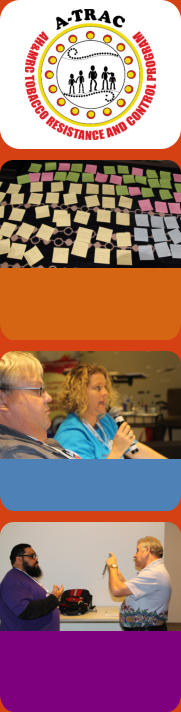
Evaluation doesn’t have to be
long. We had delegates using
post-it notes to let us know what
they liked and didn’t like!
Delegates had the opportunity to
talk about what matters to them
and their communities.
The Advisory Group sought
information by asking delegates
what they thoguht of the
Symposium using a HD video
camera.



